“Static cling” is one of the more misleading names in signage. The film that holds a promotional decal to a shop window is not clinging by static electricity in any meaningful way, and understanding what it is actually doing tells you exactly where it will work, how long it will last, and where it will disappoint you. This is a look under the surface of static cling window film: the gauge that separates it from adhesive graphics, and the environmental limits that decide whether your artwork stays put or slowly slides down the glass.
It Is Not Really Static Electricity
The cling comes from the film itself, not from a charge. Static cling window graphics are made from a highly plasticized, relatively thick vinyl. When you press a smooth sheet of it against clean, smooth glass, the two surfaces conform so closely that the film behaves like a broad, soft suction cup, holding by air pressure and surface cohesion rather than by an electrostatic charge or any adhesive. That mechanism carries a hard requirement: the receiving surface has to be smooth and non-porous. Static cling performs on glass, acrylic and mirrors, and it does not work on textured, frosted, or heavily patterned glass, where the film cannot make continuous contact. If your window is anything other than smooth, cling is the wrong substrate no matter how good the print looks. The name stuck because early users noticed a faint electrostatic tug when peeling the vinyl, but that charge is incidental; the working force is the mechanical seal between two smooth surfaces.
Why Gauge Matters
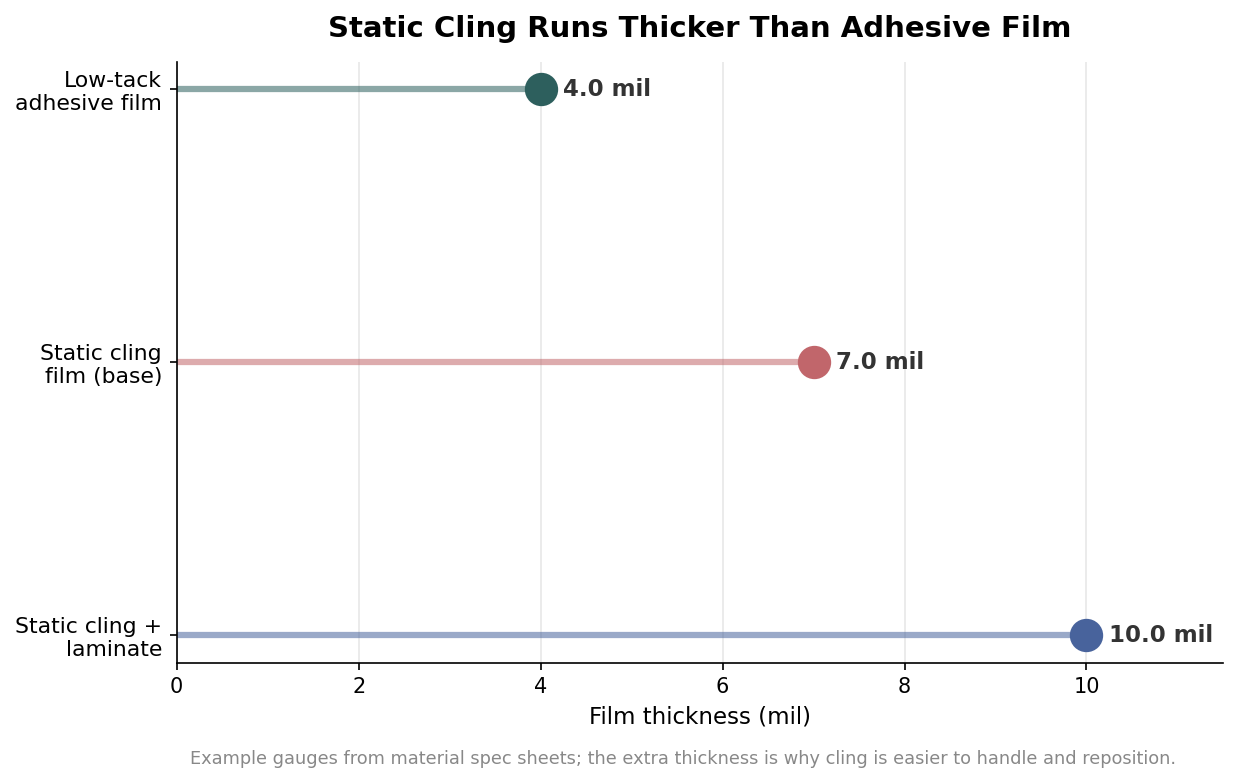
The most practical difference between cling and adhesive graphics is thickness. Static cling film is deliberately heavier: base films commonly run around 7 mil, and a laminated cling can reach roughly 10 mil, where a low-tack adhesive film in the same catalog might be about 4 mil. That extra body is not wasted. A thicker film resists curling at the edges, is far easier to reposition without creasing, and lies flatter against the glass, which is why cling is more forgiving to install by hand than a thin adhesive film that wants to fold onto itself. The trade-offs are cost, shipping weight, and the fact that a heavier film shows a harder cut edge, so full-bleed designs benefit from a clean contour cut. On large windows, that same thickness makes a one-piece cling far more manageable than wrestling a floppy adhesive sheet into place single-handed.
An Indoor Substrate, and Why
Static cling is an indoor material, and the reason is physics rather than marketing caution. Because the hold depends on continuous, conforming contact with the glass, anything that breaks that contact weakens it. Cold temperatures stiffen the vinyl, condensation and high humidity work their way between the film and the glass, and repeated thermal cycling on a sun-facing exterior pane all encourage the film to droop or peel over time. Suppliers generally designate cling as an indoor-only substrate and specifically note that it is not rated for outdoor or automotive use. If you need a graphic on the outside of the glass, on a vehicle, or anywhere exposed to weather, a pressure-sensitive adhesive film is the correct choice; cling belongs on interior-facing storefront, office and display glass.
How Long It Actually Lasts
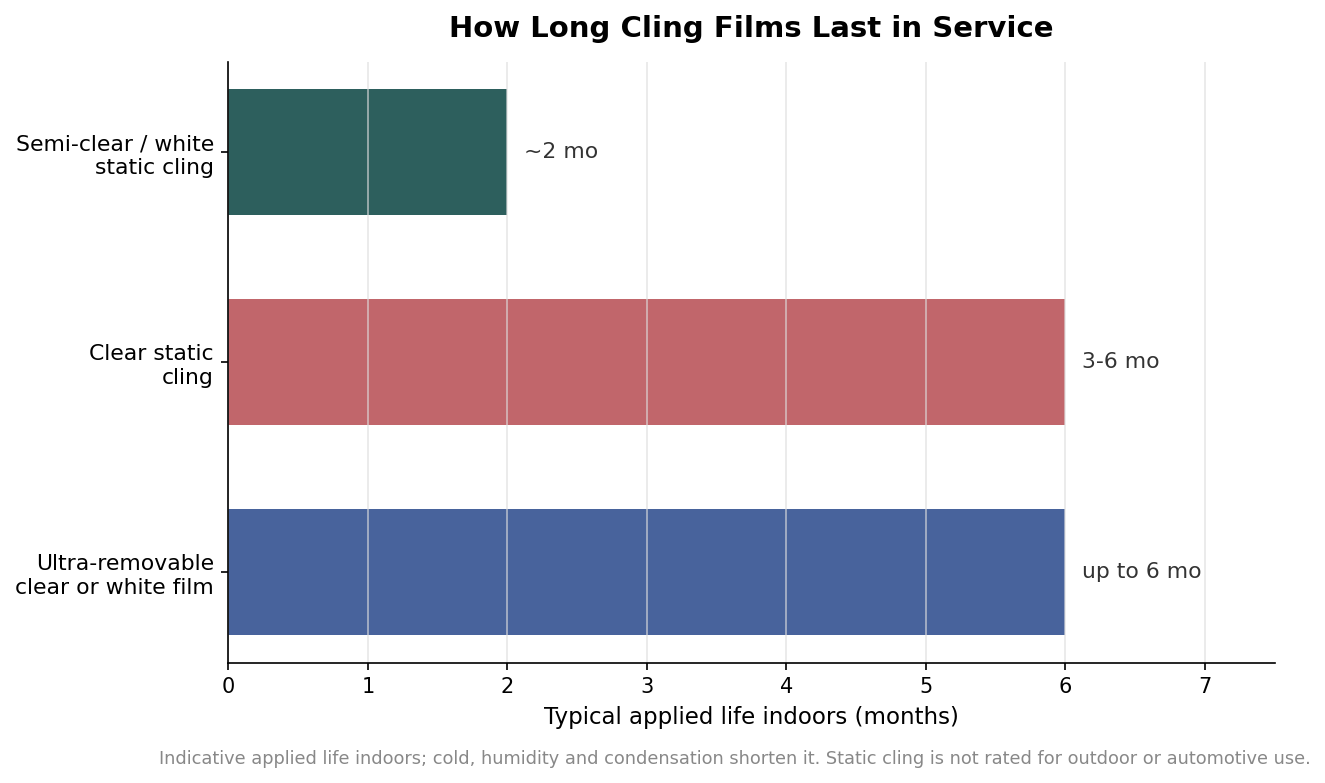
Applied life is measured in months, not years. Depending on the specific product and the environment, a standard semi-clear or white static cling might hold a clean appearance for around two months, while clearer or ultra-removable cling films are quoted in the three-to-six-month range. Environment moves those numbers in both directions: a climate-controlled office lobby is kind to cling, while a humid bathroom window or a cold entry vestibule is not. The upside of that same removable nature is reusability. A cling can be taken down and reapplied several times if you keep the clinging side clean and avoid touching it, and many users store a seasonal cling flat, with its backing sheet in place, between uses. Treat it as a repositionable, campaign-length graphic rather than a permanent fixture.
Getting a Clean First Application
Surface preparation does most of the work. Clean the glass thoroughly with glass cleaner, let it dry, and make sure no dust or lint remains, because any particle under the film becomes a visible bump and a spot where the cling lifts. A light mist of water on the glass before you apply buys you time to slide the decal into position and squeegee the air out from the center toward the edges; the water flashes off and the film settles into its suction hold. One design decision to settle before you print is which side of the glass the graphic faces. A cling applied to the inside of a window but meant to be read from the street is printed second-surface, which usually means a mirror-image print and, if you want the colors to stay punchy against daylight, a white ink layer or a white film rather than clear. Decide the viewing side first, because it changes the artwork, not just the installation.
Read in that order, the material makes sense: a thick, plasticized vinyl that holds by conforming to smooth glass, thrives indoors, lasts a season or two, and comes off cleanly to go up again. Match it to interior glass and a campaign-length job and static cling is hard to beat; ask it to survive weather or cling to texture and it will let you down. The film is honest about what it is, as long as you know what you are looking at.