Two window graphics can look identical in a proof and behave nothing alike on the glass. Static cling and adhesive vinyl decals are the two ways most shops put a logo, a promotion, or store hours onto a window, and choosing the wrong one usually shows up later as curling corners, a graphic that slid off in a cold snap, or a decal you cannot move without destroying it. This guide walks through what actually separates the two so you can order the right material the first time.
What static cling actually is
The name is misleading. Static cling holds to glass through surface tension, not static electricity. The film behaves like a sheet of microscopic suction cups: pressed flat against a smooth, non-porous surface, it clings through the cohesive force between two like surfaces. There is no adhesive involved, which is the whole point. A cling can be peeled, repositioned, rinsed clean under a tap, and put back up, often many times over.
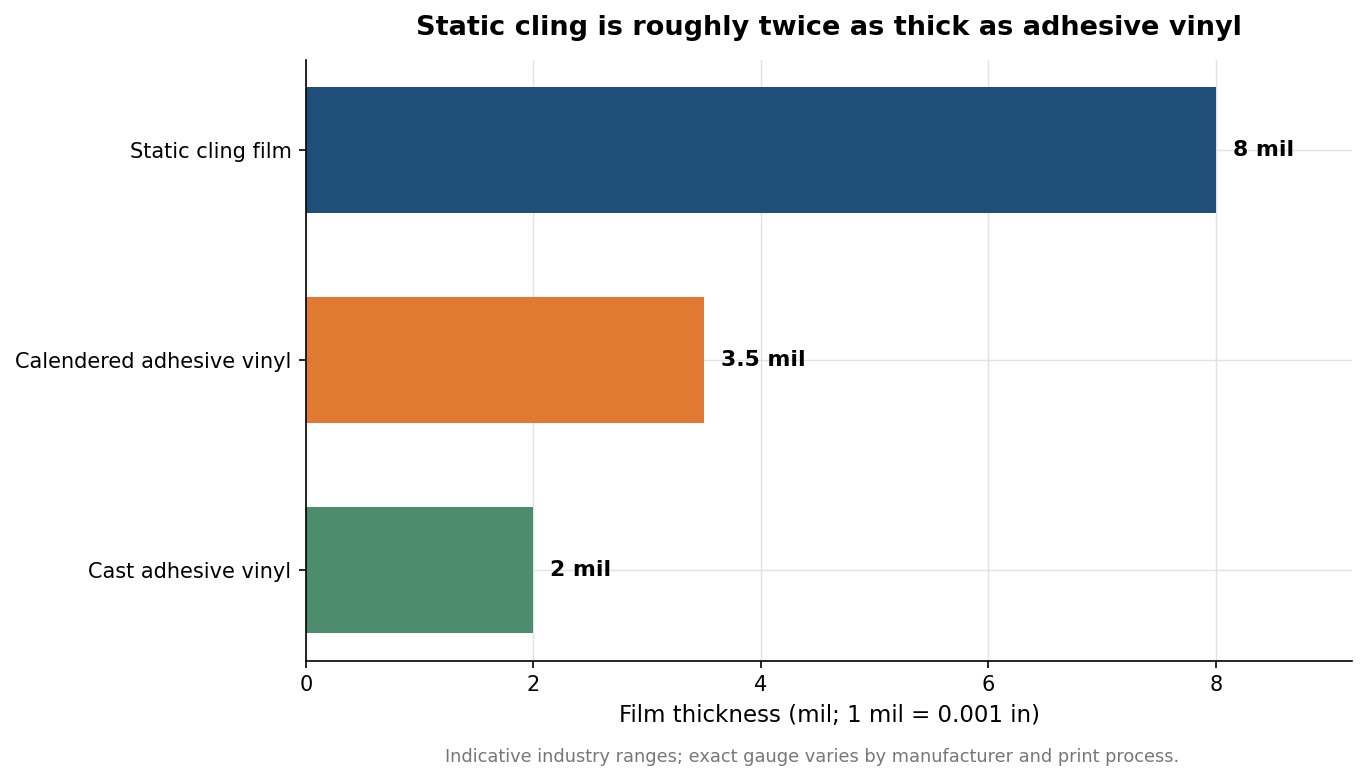
Cling film is also noticeably thick. A typical printable cling runs around 8 mil (eight thousandths of an inch), roughly twice the thickness of common adhesive vinyl. That heft is what lets it lie flat and resist curling without any glue. Because it depends on a clean, smooth bond, cling only works on glass and similar non-porous surfaces, not brick, stucco, painted drywall, or textured plastic.
Where adhesive vinyl decals differ
An adhesive vinyl decal is thinner, commonly 2 to 4 mil depending on whether it is calendered or cast vinyl, and carries a pressure-sensitive adhesive on the back. Once you squeegee it down, the bond strengthens over hours and days as the adhesive flows into the surface. That is exactly what you want for a graphic meant to stay put outdoors for years, and exactly what you do not want if you plan to move it. Removing a vinyl decal generally means heat, patience, and some adhesive residue; you are not reusing it.
The trade is permanence for versatility. Adhesive vinyl sticks to far more than glass, including metal, sealed wood, vehicle panels, and smooth walls, and it shrugs off weather that would defeat a cling. For a bumper sticker, a storefront graphic that faces the street from outside, or a vehicle wrap element, adhesive vinyl is the honest answer.
Durability, temperature, and where each one fails
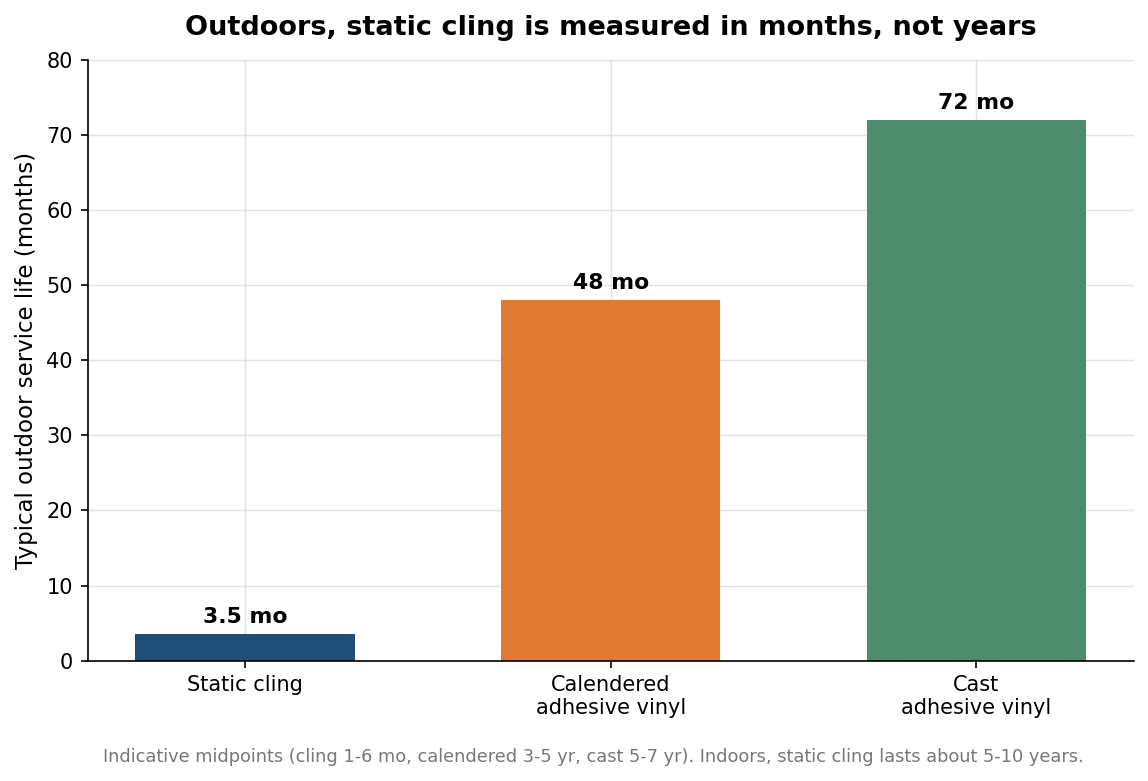
The biggest real-world difference is environment. Mounted inside on clean glass, a static cling can look good for 5 to 10 years. Put that same cling on an outward-facing surface and its working life drops to roughly 1 to 6 months, indicative figures that swing with sun, heat, and humidity. Cling struggles specifically with cold: on a cold pane, in condensation, or in high humidity, the surface-tension bond gives up and corners drop. If your climate has real winters, treat cling as an indoor product.
Adhesive vinyl runs the other way. Outdoors, calendered vinyl commonly holds for 3 to 5 years and premium cast vinyl for 5 to 7, and indoors it is effectively permanent until you decide to remove it. One shelf-life note catches buyers off guard: unprinted cling material lasts only about six months in storage because the plasticizers that keep it pliable relax over time, so order cling for a job you are running soon rather than stockpiling blank stock.
Clear or white, inside or outside the glass
Both materials come as clear or white film, and the choice changes how the graphic reads. Clear film lets the window show through around your artwork, which looks clean but leaves light-colored ink washed out against a bright background. Printing a white flood coat behind the design makes colors pop and text legible from outside, at the cost of a darker, more opaque look when seen from inside the store. Solid white film gives you full opacity edge to edge and the easiest readability for bold, simple graphics.
Mounting direction matters just as much. A graphic can be built to face out through the glass, mounted on the inside surface where it is protected from weather and tampering, or to face the street from the outside surface. The reverse-reading and the ink-layer order have to be set up correctly for the mount you choose, so tell your printer up front whether the art goes on the first or second surface. Getting this wrong is the most common reason a finished window graphic reads backward.
How to choose for your job
Reach for static cling when the graphic is temporary or seasonal, lives on interior glass, and you want to reposition or reuse it: promotions, hours, parking permits, and rotating retail messaging all fit. Reach for adhesive vinyl when the graphic faces the weather, needs to last years, or goes on any surface that is not glass. When you are genuinely unsure, ask two questions. Will this be exposed to the outdoors, and will I want to move it later? “Outdoors” points to adhesive vinyl; “I’ll move it” points to cling. If both are true, a low-tack removable adhesive vinyl is the middle path, trading some reusability for weather resistance.
On ordering, custom window clings are typically produced in a few business days for standard runs, with rush options at most shops, and per-piece cost falls steeply with quantity: small runs land at a few dollars each while larger orders drop well under a dollar. Those are indicative industry ranges, not a quote. Whatever you order, send print-ready art at the final size, confirm clear versus white and the mount surface, and you will sidestep the reprints that make window graphics feel more complicated than they need to be.