Ordering custom static cling for the first time usually starts with the same three questions: how much will it cost, how few can I order, and how long will it take to show up. The answers vary more than you’d expect between printers, mostly because “static cling” covers a range of vinyl thicknesses, finishes, and order structures that aren’t obvious from a homepage banner. Get the spec wrong and you either overpay for a run size you don’t need or end up with clings too thin to survive a storefront window through a full season.
This guide walks through what printers actually charge per unit, what minimum order quantities look like across the market, the material differences between clear and white static cling vinyl, and realistic turnaround windows so you can plan a launch date instead of guessing at one.
Source: Vograce product page and GotPrint product page, accessed August 2026
How custom static cling pricing actually breaks down
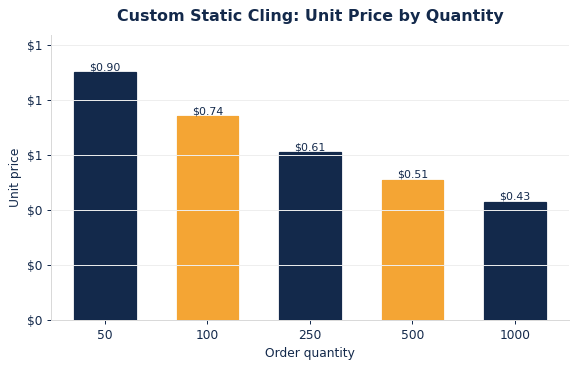
Static cling is priced almost entirely on volume, not on design complexity, since full-color digital printing costs the same whether the artwork is one color or twelve. The steepest price drop happens between the smallest and mid-size tiers, which is why buyers testing a design often order more than they think they need just to hit a better per-unit rate.
Vograce’s published pricing for custom static cling stickers is a useful reference point because it shows the curve clearly: 10 pieces run about $0.82 each, and that per-unit price keeps falling as the order grows, landing around $0.34 each once you’re ordering 1,000 or more. Between those points, the discount isn’t linear — the biggest jump comes going from a 10-piece order to a 50-piece order, where the unit price nearly drops in half.
Other printers price differently. GotPrint, for example, quotes by job rather than strictly per-sticker at low volumes — a single 11″ x 17″ window cling starts around $15.31, which reflects setup and material costs being spread across very few units. If you only need one or two large clings for a storefront, a per-job quote like that can actually beat a per-unit price built for bulk runs.
Minimum order quantities vary more than you’d expect
There’s no industry-standard minimum for custom static cling, which makes it worth checking before you commit to a design. Some printers built their business around one-off and small-batch orders; others are set up for retailers and franchises ordering hundreds of identical clings per location and price accordingly.
If you only need a handful — say, a sample for one storefront or a single event booth — a no-minimum printer saves you from paying for stock you don’t need. If you’re outfitting multiple locations or running a promotion across a chain, the printers with a 50- or 100-piece floor tend to have better per-unit economics once you’re past that threshold anyway.
| Printer | Minimum Order Quantity |
|---|---|
| StickerYou | No minimum (order 1) |
| GotPrint | No minimum (order 1) |
| Vograce | 10 pieces per design |
| Stickerbeat | 50 pieces per design |
| Plus Printers | 100 pieces |
Material specs: clear vs. white, and why thickness matters
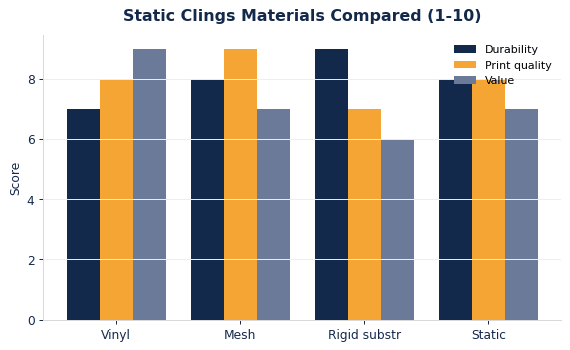
Static cling vinyl works because it’s a soft, slightly tacky plastic film that grips smooth glass through static attraction rather than adhesive — no residue, no sticky edges left behind when it comes down. That softness comes from the film’s thickness, and most printers use 7 to 8 mil vinyl for custom static cling, thick enough to lie flat against glass without curling at the corners but still thin enough to apply and reposition by hand.
The two base materials are clear gloss and white opaque. Clear cling is applied to the inside of a window so the design reads correctly from outside, and works well when you want the glass itself to stay visible around the artwork. White opaque cling blocks light through the printed area entirely, which makes colors pop and is the better choice for full-coverage graphics, logos, or anything that needs to read clearly against a bright background on either side of the glass.
Indoor vs. outdoor durability
Static cling is built for temporary and rotating use rather than permanent signage. Industry material specs put indoor durability at up to about 2 years, while outdoor exposure — sun, temperature swings, rain — cuts that down to roughly 3 months before the film starts to curl or fade. If a graphic needs to survive a full season outdoors, adhesive vinyl is the better material; static cling is the right call for anything you plan to swap out, like seasonal storefront displays, temporary promotions, or event graphics.
Lead times: what to actually expect
Turnaround claims are easy to skim past, but they matter for anything tied to a launch date, event, or seasonal window. Production time — the time the printer needs to actually make your clings — is usually quoted separately from shipping, and the two combined can add several days to whatever number is on the homepage.
On the fast end, GotPrint quotes 2 to 5 business days for printing once a proof is approved, and Print Pronto lists 3 to 5 business days for standard production. Vograce quotes 7 to 10 business days for custom static cling, excluding proofing and shipping. On the slower end, printers handling more complex or larger-format jobs, like Plus Printers, quote 12 to 15 days. If a project has a hard deadline, build in the proofing round and shipping transit time on top of whichever production window your printer quotes — a rush option is usually available for an added fee if you’re cutting it close.
Sizing and where custom static cling works best
Because static cling doesn’t use adhesive, it’s the material of choice anywhere a graphic needs to come down clean and get swapped out: retail storefront windows for seasonal promotions, car dealership glass for pricing and feature call-outs, restaurant windows for menu updates or hour changes, and event or trade show booths where the same glass panel gets reused for the next show. It’s also popular for real estate window displays and for company vehicles that need removable branding without leaving glue residue on a leased vehicle.
Standard sizes run from small logo-sized pieces a few inches across up to full window panels over a foot wide — most printers cut to custom dimensions rather than fixed sizes, so measure your actual glass before ordering rather than guessing at a standard size. For odd shapes or multi-panel storefronts, ask whether the printer offers a template or measurement guide; getting the dimensions wrong is the most common (and most expensive) mistake on a first order.
What to send your printer before you order
A print-ready file moves a custom static cling order through proofing fastest when it includes a few things up front: final artwork at full size and at least 150 DPI, the exact finished dimensions in inches, whether you need clear or white base material, and the quantity per design if you’re ordering more than one graphic. If your design includes text that needs to read correctly from outside the glass, flag that clearly — mirrored text is a common ordering mistake with clear static cling specifically.
It’s also worth asking upfront whether the quote includes die-cutting to a custom shape or only rectangular cuts, since shaped cutting sometimes carries a small additional charge. Getting these details settled before the proof stage avoids a second round of revisions that can eat into your lead time.
Frequently asked questions
What’s the minimum order for custom static cling?
It depends on the printer. Some, like StickerYou and GotPrint, will print a single piece with no minimum. Others set a floor per design — Vograce requires 10 pieces, and Stickerbeat requires 50. If you only need one or two clings, look for a no-minimum printer rather than paying for a bulk run you don’t need.
How much does custom static cling cost per piece?
Published tiered pricing from Vograce shows about $0.82 per piece at a 10-piece order, dropping to roughly $0.47 at 100 pieces and $0.34 at 1,000 pieces. Very small, single-item orders from other printers are often quoted as a flat job price instead — for example, around $15.31 for one 11″ x 17″ window cling at GotPrint — since the cost isn’t purely volume-based at that scale.
Should I order clear or white static cling?
Clear static cling works best when you want the window glass to stay visible around your design and the graphic is applied to the inside surface. White opaque cling blocks light through the printed area and gives you more color saturation, which is the better pick for logos, full-coverage graphics, or anything that needs to read clearly regardless of what’s behind the glass.
How long does static cling last, indoors vs. outdoors?
Static cling vinyl is rated for roughly 2 years of indoor durability but only about 3 months outdoors, since sun and temperature exposure cause the film to curl and fade faster. If a graphic needs to survive a full season outside, adhesive vinyl signage holds up longer than static cling.
How long does a custom static cling order take to arrive?
Production time alone ranges from about 2–5 business days at faster printers up to 12–15 days for larger or more complex jobs, and that’s before shipping transit time. Ask whether the quoted lead time starts at order placement or at proof approval, since the proofing round can add extra days if it’s not accounted for.
Can static cling be cut into a custom shape?
Most printers offer die-cutting to a custom outline in addition to standard rectangular or square cuts, though it can carry a small additional charge. Confirm this before ordering if your design isn’t a basic rectangle, since shape cutting affects both price and production time.
The bottom line
The right custom static cling order comes down to matching quantity, material, and lead time to what you’re actually putting up. A single storefront test run doesn’t need the same printer or pricing structure as a 500-piece rollout across multiple locations, and clear vinyl solves a different problem than white opaque. Confirm the minimum order quantity, the mil thickness, and whether the quoted lead time includes proofing before you submit artwork — those three checks catch most of the surprises that show up after an order is already placed.